
TAVI (TRANSCATHETER AORTIC VALVE IMPLANTATION)
Home > Services > TAVI (TRANSCATHETER AORTIC VALVE IMPLANTATION)
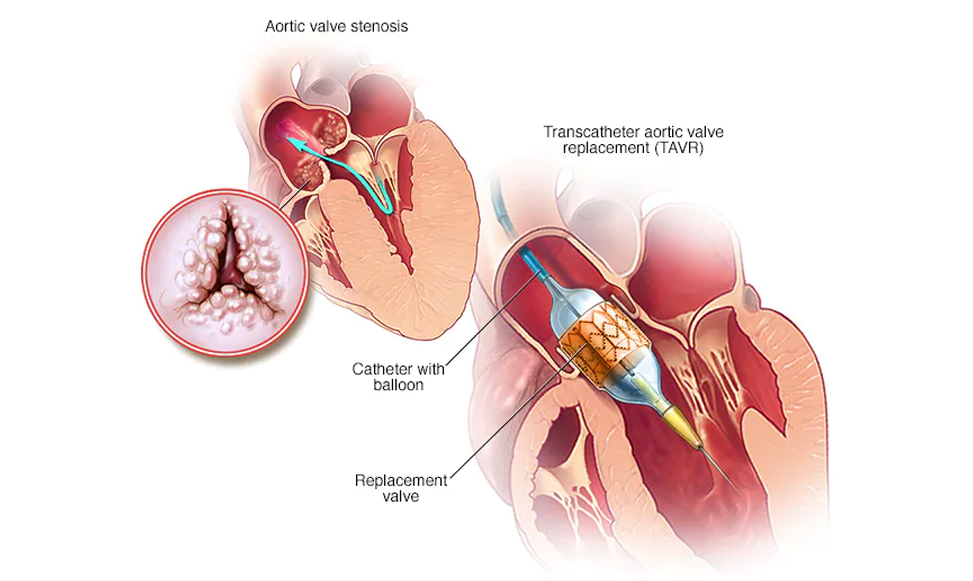
Transcatheter Aortic Valve Implantation (TAVI), also frequently referred to as Transcatheter Aortic Valve Replacement (TAVR), is a revolutionary, minimally invasive procedure used to replace a thickened, narrowed aortic valve that fails to open properly (aortic stenosis). The aortic valve is the main gateway that allows oxygen-rich blood to be pumped from the heart out to the rest of the body. When it becomes stiff and calcified, the heart has to work dangerously hard to push blood through the narrowed opening, leading to heart failure, chest pain, and a high risk of sudden death. Instead of cutting open the chest and temporarily stopping the heart, an interventional cardiologist or cardiovascular surgeon uses a specialized catheter to deliver a fully collapsible replacement valve directly to the site of the old one, instantly restoring healthy blood flow and significantly extending the patient’s life.
1. Indications:
TAVI has rapidly become the standard of care for many patients with severe aortic stenosis. Originally reserved only for patients too sick for surgery, it is now widely approved across various risk levels. Common indications include:
- Severe Symptomatic Aortic Stenosis: Patients experiencing shortness of breath, fainting (syncope), extreme fatigue, or chest pain (angina) during exertion.
- High and Intermediate-Risk Patients: Individuals whose age, frailty, or co-existing medical conditions (like severe lung or kidney disease) make traditional open-heart surgery too dangerous.
- Low-Risk Patients: Recent clinical guidelines have expanded TAVI to younger, healthier patients as a highly effective alternative to surgical valve replacement.
- Valve-in-Valve Procedures: Patients who have previously had an open-heart biological tissue valve replacement that is now failing, allowing doctors to place a new TAVI valve directly inside the old surgical one without repeating open-heart surgery.
2. Procedure:
A TAVI procedure is performed in an advanced hybrid operating room or a highly equipped cardiac cath lab. It is frequently done under conscious sedation (meaning you are awake but heavily relaxed and pain-free), though general anesthesia is sometimes used.
The doctor makes a small puncture in a major artery, usually the femoral artery in the groin (transfemoral approach). If the leg arteries are too narrowed by plaque, alternative access points like the artery in the neck (carotid) or under the collarbone (subclavian) may be used.
Through this small access point, a thin, flexible catheter is gently navigated up into the heart and carefully guided across the narrowed aortic valve using continuous X-ray imaging (fluoroscopy) and ultrasound (echocardiogram).
The new valve made of biological tissue (often cow or pig heart tissue) supported by a collapsible metal stent frame is crimped tightly onto the end of the delivery catheter. Once perfectly positioned inside the diseased valve, the new valve is expanded. Some valves are expanded by inflating a small balloon, while others are made of a “memory metal” that self-expands when released from the catheter sheath. The new valve powerfully pushes the old, calcified leaflets out of the way and takes over the job of regulating blood flow immediately. The delivery catheter is then removed. The procedure typically takes 1 to 2 hours, and many patients are walking the same day and discharged within 24 to 48 hours.
3. Safety:
TAVI is a highly successful procedure that avoids the trauma of a cracked sternum and the use of a heart-lung bypass machine, resulting in drastically less pain and a much faster recovery than traditional open-heart surgery.
While generally very safe, the procedure is complex and carries certain risks, including:
- Bleeding, bruising, or a hematoma at the catheter insertion site (groin or neck).
- Stroke: A piece of the old calcified valve can break loose during the procedure and travel to the brain (many centers now use a temporary embolic protection device a tiny net in the neck arteries during the procedure to catch these particles).
- Need for a Permanent Pacemaker: The new valve expands very close to the heart’s electrical system. The pressure can sometimes disrupt these electrical signals (heart block), requiring the implantation of a pacemaker in the days following the procedure.
- Paravalvular Leak (PVL): A small gap between the new valve frame and the irregular, calcified walls of the old valve, allowing a small amount of blood to leak backward.
- Injury to the blood vessels as the large delivery catheter is navigated to the heart.