

PHYSIOLOGY GUIDED STENTING AND THEN- FRACTIONAL FLOW RESERVE (FFR)
Home > Services > Physiology-guided stenting using Fractional Flow Reserve (FFR)
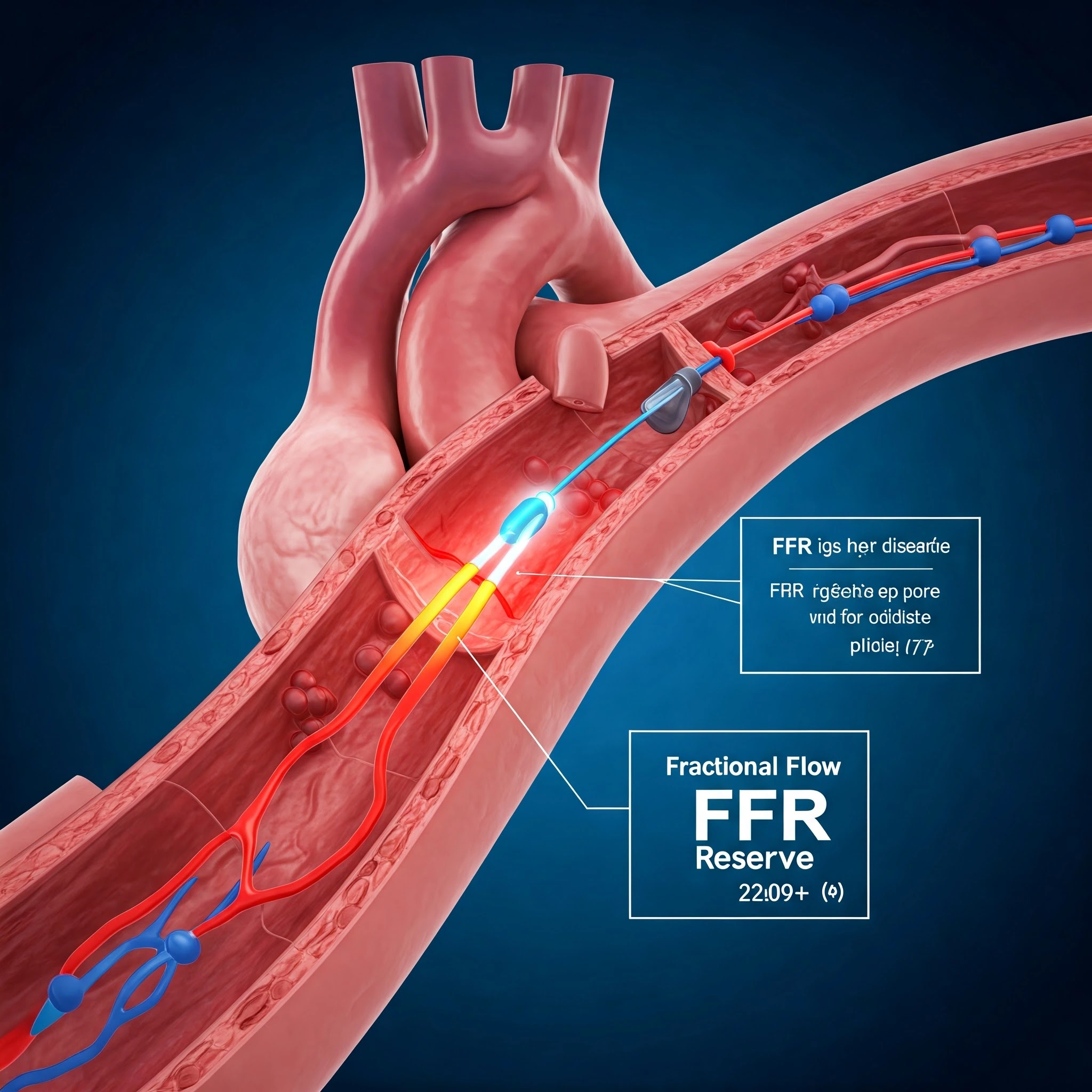
Physiology-guided stenting using Fractional Flow Reserve (FFR) is a highly precise, evidence-based approach to treating coronary artery disease. Traditionally, cardiologists relied on X-ray angiograms to visually estimate the severity of a blockage. However, visual estimation cannot always confirm if a blockage is actually restricting blood flow. FFR solves this by using a specialized, pressure-sensing guidewire to measure exactly how a narrowing affects the actual flow of oxygen-rich blood to the heart muscle. This advanced technology allows the doctor to confidently determine if a specific blockage truly requires a stent, or if it can be safely and effectively managed with medication alone.
1. Indications:
Physiology-guided stenting using FFR is recommended for patients when visual angiogram results are borderline or inconclusive. Common indications include:
“Intermediate” coronary blockages (typically a 40% to 70% narrowing) where it is unclear if blood flow is significantly restricted
Multi-vessel coronary artery disease, to precisely identify which specific blockages are causing symptoms and require stenting
Patients with stable chest pain (angina) to ensure stents are only placed where they will provide a true clinical benefit
Guiding complex interventions to avoid the risks and costs of placing unnecessary stents
Evaluating a newly placed stent to confirm that optimal, healthy blood flow has been fully restored
Using FFR ensures you receive the exact treatment you need—nothing more, and nothing less.
2. Procedure:
An FFR assessment is performed seamlessly during a standard coronary angiogram in the cath lab under local anesthesia. You will remain awake and comfortable.
Once the catheter is positioned at the heart, the doctor advances a microscopic guidewire equipped with a tiny pressure sensor directly across the blockage in question. A medication (such as adenosine) is temporarily administered through an IV. This medication dilates the blood vessels, simulating the increased blood flow that occurs during physical exercise.
The sensor then measures the blood pressure behind the blockage and compares it to the normal pressure in front of the blockage. This creates a ratio (the FFR value).
- An FFR value of 0.80 or lower indicates a significant restriction in blood flow, meaning a stent is necessary and will relieve symptoms.
- An FFR value above 0.80 means the blockage is not severe enough to restrict flow, and a stent can be safely avoided in favor of medical therapy.
If a stent is required, the doctor can proceed with the angioplasty immediately using the same guidewire.
3. Safety:
Physiology-guided stenting with FFR is a highly safe procedure and is recognized as the gold standard of care by major international cardiology guidelines. By utilizing FFR, doctors significantly reduce the risks associated with placing unnecessary stents, leading to better long-term outcomes for patients.
The risks are nearly identical to those of a standard angiogram, and possible but uncommon risks include:
- A temporary sensation of flushing, shortness of breath, or chest heaviness from the adenosine medication (this resolves within seconds)
- Bleeding, bruising, or a hematoma at the catheter insertion site (wrist or groin)
- Injury or dissection of the coronary artery by the pressure wire
- Allergic reaction to the contrast dye used during the imaging process