
PRIMARY ANGIOPLASTY & THROMBOSUCTION
Home > Services > Primary angioplasty & thrombosuction
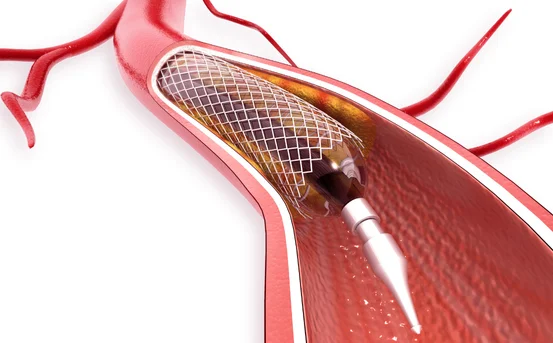
Primary angioplasty is a life-saving, emergency procedure performed during an acute heart attack. A heart attack occurs when a coronary artery suddenly becomes completely blocked by a blood clot, instantly starving the heart muscle of oxygen. “Time is muscle” the faster this blockage is opened, the more heart muscle is saved. In cases where the artery is choked by a massive blood clot, a specialized technique called thrombosuction (or aspiration thrombectomy) is used alongside angioplasty. During this process, a miniature vacuum catheter is carefully navigated to the blockage to literally suck out the blood clot before a stent is placed. This clears the vessel, prevents pieces of the clot from breaking off and traveling deeper into the heart, and ensures the best possible blood flow recovery.
1. Indications:
Primary angioplasty with thrombosuction is strictly an emergency intervention recommended for patients experiencing an active, life-threatening cardiac event. Indications include:
- An acute, major heart attack (specifically known as a STEMI – ST-Elevation Myocardial Infarction)
- Sudden, severe chest pain, pressure, or tightness accompanied by sweating, nausea, or shortness of breath
- An emergency coronary angiogram that reveals a very high “clot burden” (a large amount of fresh blood clot blocking the artery)
- The need to quickly restore blood flow to prevent irreversible heart muscle death, heart failure, or fatal arrhythmias
- Cases where a blood clot is too large for a balloon and stent to safely compress without pushing debris further down the artery
Immediate emergency treatment is the most critical factor in surviving a heart attack and preserving long-term heart function.
2. Procedure:
Because this is a medical emergency, the procedure is performed immediately upon the patient’s arrival at the hospital in a 24/7 cardiac cath lab. You will be given local anesthesia and fast-acting medications, including powerful blood thinners. Access is quickly gained through a small puncture in the wrist (radial artery) or groin (femoral artery).
A flexible catheter is rapidly advanced to the heart under X-ray imaging. Once the blocked artery is located, a specialized hollow aspiration catheter is guided over a microscopic wire directly into the clot. Using negative pressure (suction) attached to a syringe outside the body, the doctor vacuums the clot out of the artery.
Once the heavy clot is removed and the vessel is cleared, a tiny balloon is inflated to compress any remaining cholesterol plaque. Finally, a drug-eluting stent (a tiny metal mesh tube) is firmly deployed to keep the artery permanently open and restore vital oxygen-rich blood flow to the dying heart muscle. The entire procedure is highly time-sensitive and is typically completed in under an hour.
3. Safety:
Primary angioplasty is the absolute gold-standard treatment for a heart attack worldwide. When performed rapidly by an expert interventional cardiologist and a dedicated emergency cath lab team, it is highly successful and dramatically increases survival rates.
While it is a life-saving procedure, it is performed on patients who are already critically ill from a heart attack, which naturally carries risks. Possible but uncommon risks associated with the procedure include:
- Bleeding, bruising, or a hematoma at the emergency puncture site
- Irregular heartbeats (arrhythmias), which are common as blood flow suddenly rushes back into the starved heart muscle (reperfusion)
- Temporary decline in kidney function due to contrast dye or the stress of the heart attack
- Allergic reaction to the X-ray contrast dye
- Injury, tearing, or dissection of the coronary artery
- Blood clot formation within the new stent, requiring strict adherence to prescribed blood thinners after the procedure