

CAROTID ARTERY STENTING
Home > Services > Carotid Artery Stenting
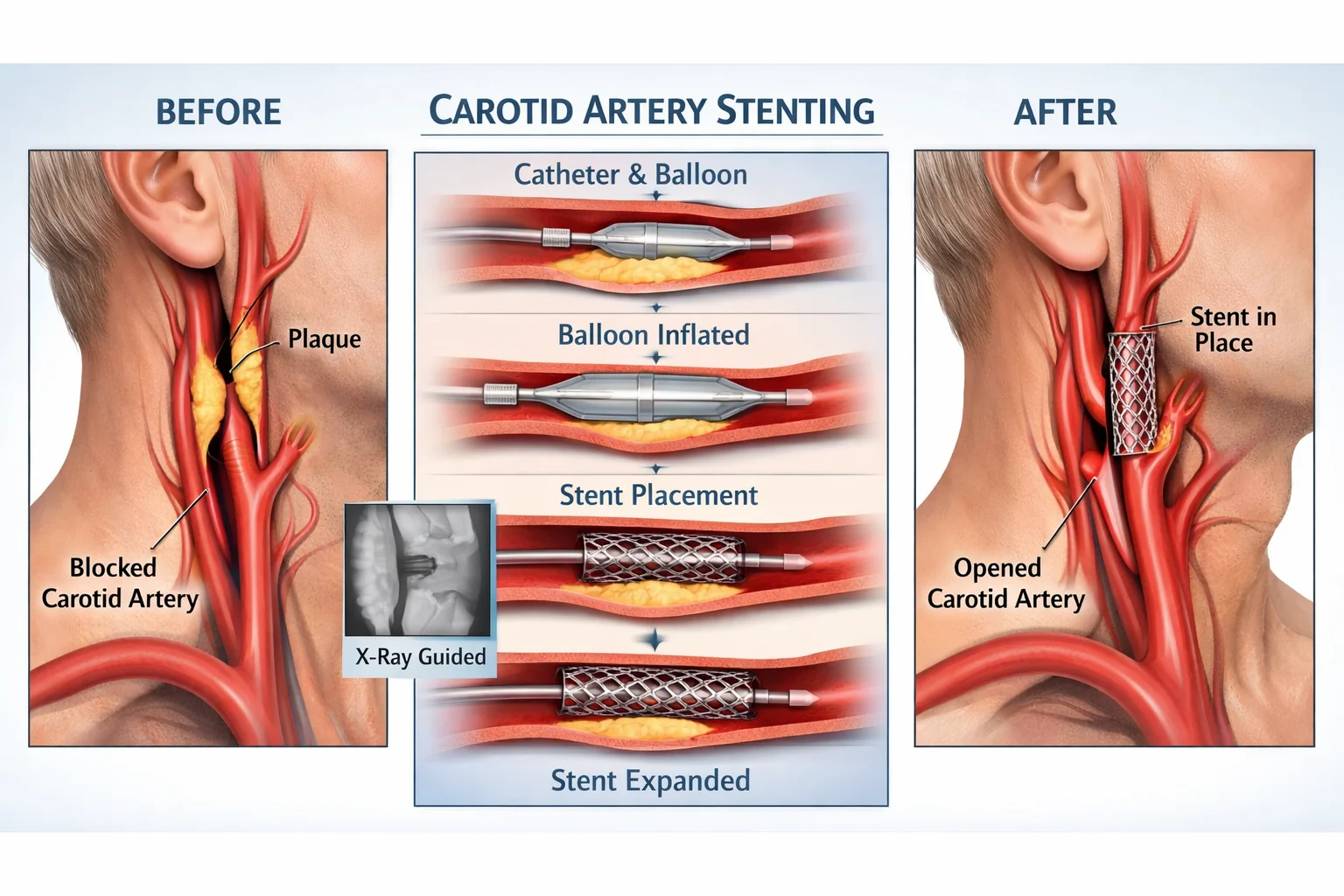
Carotid artery stenting is a minimally invasive, life-saving procedure used to treat severe narrowing or blockages in the carotid arteries—the two main blood vessels in your neck that supply oxygen-rich blood to your brain. Over time, a buildup of cholesterol and calcium (plaque) can harden and narrow these arteries, a condition known as carotid artery disease. If a piece of this plaque breaks off or a blood clot forms, it can travel to the brain and cause a devastating stroke. During a stenting procedure, a specialist uses a specialized catheter to safely widen the artery with a balloon and permanently place a small wire mesh tube (stent) inside. This stent acts as a scaffold to hold the artery wide open, trapping the plaque against the vessel wall and restoring healthy blood flow to the brain without the need for major neck surgery.
1. Indications:
Carotid artery stenting is recommended to prevent a stroke in patients with significant blockages, particularly those who are considered high-risk for traditional open surgery (carotid endarterectomy). Common indications include:
- A severe blockage (usually greater than 70%) in the carotid artery
- Patients who have already experienced stroke-like symptoms, such as a Transient Ischemic Attack (TIA) or a minor stroke, caused by the narrowed artery
- Patients with medical conditions—such as severe heart disease, lung disease, or prior heart failure—that make general anesthesia and open neck surgery too dangerous
- Patients who have had previous surgery or radiation therapy on their neck, making open surgery technically difficult
- Restenosis, which is the re-narrowing of a carotid artery that was previously treated with open surgery
- Blockages that are located very high up in the neck or very low near the collarbone, where a surgeon cannot easily reach them
By permanently opening the artery and trapping the dangerous plaque, this procedure drastically reduces the long-term risk of a major stroke.
2. Procedure:
Carotid artery stenting is performed in a highly equipped cath lab by an interventional specialist. The procedure is typically done under local anesthesia with mild sedation. It is important that you remain awake and able to respond to simple commands (like squeezing a soft ball or answering questions) so the doctor can continuously monitor your brain function during the procedure.
A small puncture is made in an artery in the groin (femoral artery) or the wrist (radial artery). Through this access point, a thin, flexible catheter is gently navigated up to the narrowed carotid artery in the neck using continuous X-ray imaging (fluoroscopy).
Before the blockage is treated, the doctor deploys a crucial safety tool called an Embolic Protection Device (EPD). This is a microscopic, umbrella-like filter placed just past the blockage. Its job is to catch any tiny pieces of plaque or debris that might break loose during the procedure, preventing them from reaching the brain. Once the filter is in place, a tiny balloon is inflated to compress the plaque. A self-expanding metal stent is then deployed to permanently hold the artery open. Finally, the balloon, catheters, and the filter (safely holding any trapped debris) are completely removed. The procedure takes about 1 to 2 hours, and most patients go home the next day.
3. Safety:
Carotid artery stenting is a highly advanced, safe, and effective alternative to open neck surgery. Because it is minimally invasive, it avoids a large incision on the neck, significantly reduces recovery time, and eliminates the risk of surgical nerve damage that can affect swallowing or speaking.
Continuous monitoring of your vital signs and neurological status is maintained throughout the procedure. While complications are uncommon, possible risks include:
- A stroke or TIA during the procedure, if a piece of plaque manages to bypass the protective filter and travel to the brain
- Bleeding, bruising, or a hematoma at the catheter insertion site (groin or wrist)
- A temporary, sudden drop in heart rate or blood pressure when the balloon is inflated in the neck (the medical team manages this instantly with medications)
- Temporary decline in kidney function due to the contrast dye used for X-ray imaging
- Allergic reaction to the contrast dye
- Re-narrowing of the stented artery over time (restenosis)