

ASPIRATION THROMBECTOMY IN PULMONARY EMBOLISM & ACUTE PERIPHERAL VESSEL THROMBOTIC OCCLUSION
Home > Services > ASPIRATION THROMBECTOMY IN PULMONARY EMBOLISM & ACUTE PERIPHERAL VESSEL THROMBOTIC OCCLUSION
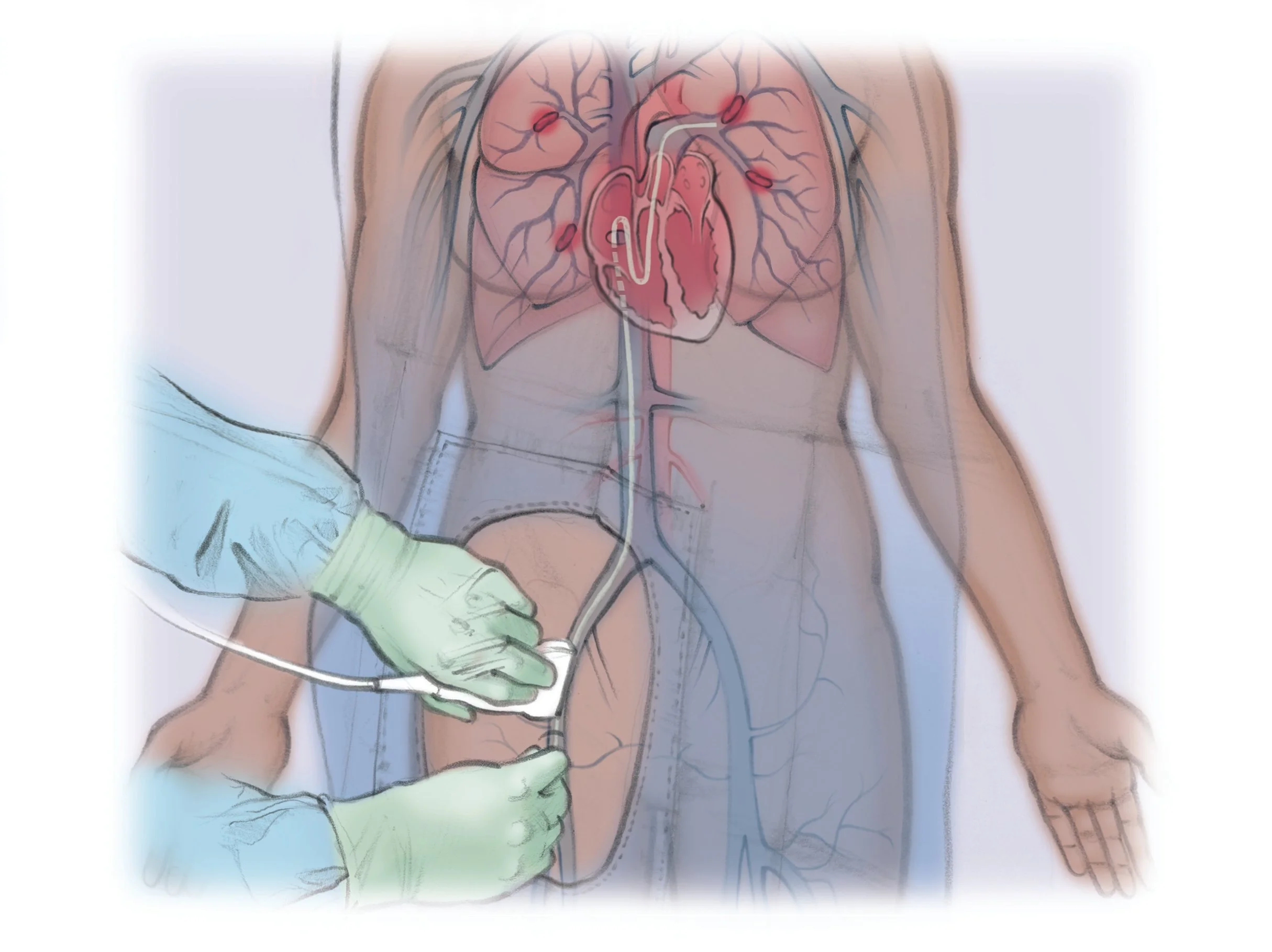
Aspiration thrombectomy is a highly advanced, life-saving, and limb-saving minimally invasive procedure used to rapidly remove large, dangerous blood clots. When a massive blood clot suddenly blocks an artery in the lungs (Pulmonary Embolism) or a vital blood vessel in the arms or legs (Acute Peripheral Vessel Thrombotic Occlusion), it creates a critical medical emergency. The sudden blockage can cause severe heart strain, respiratory failure, or rapid tissue death in the limbs. Instead of relying solely on slow-acting blood thinners or high-risk open surgery, an interventional cardiologist uses a specialized catheter system to navigate directly to the clot and apply powerful mechanical suction. This vacuums the clot out of the body in real-time, instantly restoring healthy blood flow and rapidly stabilizing the patient.
1. Indications:
Aspiration thrombectomy is recommended for emergency situations where a blood clot poses an immediate threat to life or limb viability. Common indications include:
Massive or submassive Pulmonary Embolism (PE) causing right heart failure, extremely low blood pressure, or severe shortness of breath
Acute Limb Ischemia—a sudden, critical blockage in a peripheral artery causing severe leg or arm pain, coldness, numbness, and a loss of pulse
Extensive Deep Vein Thrombosis (DVT) in the legs or pelvis that causes extreme swelling and threatens to cut off circulation entirely (Phlegmasia Cerulea Dolens)
Patients with critical clots who cannot safely receive powerful clot-busting medications (thrombolytics) due to a high risk of bleeding (such as those with a recent surgery, trauma, or previous stroke)
Situations where standard blood thinners have failed to stop a clot from growing or causing severe symptoms
By instantly extracting the clot, this procedure rapidly reduces dangerous pressure on the heart and prevents permanent tissue death or amputation in the limbs.
2. Procedure:
An aspiration thrombectomy is performed in a highly equipped cardiac or vascular cath lab. Because it is often an emergency procedure, you will be given local anesthesia at the access site and mild sedation to keep you calm, but you will remain awake.
A small puncture is made in an appropriate blood vessel—usually the femoral vein or artery in the groin, or sometimes behind the knee or in the neck, depending on where the clot is located. Through this small access point, a thin, flexible catheter is gently navigated up to the exact site of the blockage using continuous X-ray imaging (fluoroscopy).
Once positioned directly against the clot, the doctor utilizes a state-of-the-art aspiration device (such as the Inari FlowTriever or Penumbra system). The device acts like a powerful, miniature vacuum. The doctor activates the suction, which grips the clot and physically pulls the solid mass inside the large-bore catheter, removing it from the body. Blood flow is immediately restored. The catheters are then completely removed. The procedure typically takes 1 to 2 hours, and patients often experience immediate relief of symptoms like shortness of breath or severe leg pain.
3. Safety:
Aspiration thrombectomy is a critical, highly effective intervention that frequently saves lives and limbs. Because it is catheter-based, it avoids the massive trauma and prolonged recovery associated with open surgical clot removal (embolectomy).
You will be closely monitored in an intensive care unit (ICU) immediately following the procedure. While it is highly safe when performed by an expert team, possible risks include:
- Bleeding, bruising, or a hematoma at the catheter insertion site
- Anemia or a drop in blood counts, as a small amount of blood is inevitably suctioned out along with the clot (a blood transfusion is occasionally required)
- Injury, tearing, or dissection of the blood vessel as the large catheter is navigated through
- Distal embolization, where tiny fragments of the clot break off during the vacuum process and travel further downstream
- Temporary, irregular heartbeats (arrhythmias) when the catheter passes through the chambers of the heart to treat a pulmonary embolism
- Temporary decline in kidney function due to the contrast dye used for X-ray imaging