Fast heart rhythms
May record episodes of supraventricular tachycardia, atrial fibrillation, atrial flutter or other tachyarrhythmias when they occur during monitoring.
A small wearable ECG recorder that continuously tracks your heartbeat during normal daily activities, helping identify rhythm problems that may not appear during a short clinic ECG.
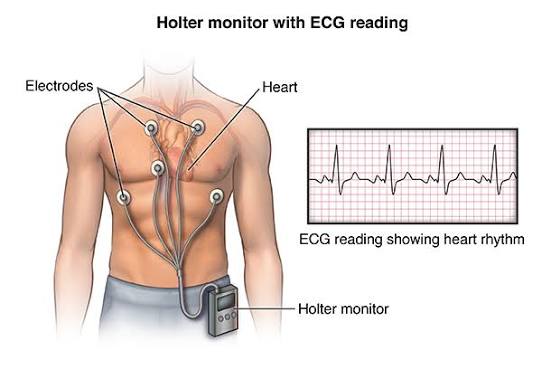
Holter monitoring is a painless, non-invasive test that records the heart’s electrical activity continuously while you move through your normal day and sleep. Small adhesive electrodes are placed on the chest and connected to a lightweight recording device worn on a belt, strap, pouch or patch, depending on the system used.
A standard electrocardiogram records only a brief moment. Palpitations, pauses, fast rhythms or slow rhythms may occur intermittently and disappear before a clinic ECG is performed. Holter monitoring increases the chance of capturing these episodes by recording many hours of heartbeats outside the hospital.
Electrodes are attached to prepared areas of the chest and connected to the recorder.
The device records your rhythm while you work, walk, rest, eat and sleep.
The recording is analysed and compared with the timing of symptoms and activities.
The report provides a detailed record of heart rate and rhythm over time. Findings must be interpreted together with symptoms, clinical history, ECG and other cardiac tests.
May record episodes of supraventricular tachycardia, atrial fibrillation, atrial flutter or other tachyarrhythmias when they occur during monitoring.
Can identify significant bradycardia, long pauses or rhythm patterns that may suggest sinus-node or conduction-system problems.
Measures premature atrial contractions and premature ventricular contractions, including their frequency, pattern and relationship to symptoms.
May document pauses or delayed electrical conduction between the upper and lower chambers, including episodes that occur during sleep.
Helps determine whether palpitations, dizziness, breathlessness or near-fainting occurred at the same time as a rhythm change.
May help assess heart-rate control, anti-arrhythmic treatment or rhythm after selected cardiac procedures when clinically appropriate.
Holter monitoring is most useful when the clinical question can be answered by continuous rhythm recording during the selected monitoring period.
These tests all record electrical activity, but the duration and method differ. The best choice depends mainly on symptom frequency and the clinical concern.
A quick snapshot taken in the clinic. It is valuable when the abnormal rhythm is present during the recording, but intermittent episodes may be missed.
Records continuously for a day or more. It is useful when symptoms or rhythm changes are expected to occur during the monitoring period.
Can record for longer periods and may be better when symptoms occur only every few days or weeks. Some devices record automatically; others require activation.
Preparation is simple, but following the centre’s instructions helps the electrodes stay attached and improves recording quality.
Fitting usually takes a short time. No injection, anaesthesia or hospital admission is normally required.
Small areas of the chest are cleaned. Limited hair may be clipped or shaved so the electrodes adhere securely.
Adhesive electrodes are positioned on the chest according to the recording system.
Leads are connected to the portable recorder, or a compact patch device is placed directly on the skin.
The technician confirms that the device is recording clearly and that the electrodes are secure.
You are shown how to protect the monitor, note symptoms and use an event button when the device includes one.
After the prescribed period, the device is returned or removed so the recording can be analysed and reported.
The purpose is to record your heart during a representative day. Follow the specific instructions supplied with your device because models differ.
Work, walk, eat and sleep as normally as possible unless your doctor has restricted a particular activity. Avoid deliberately overexerting yourself just to provoke symptoms.
Do not bathe, shower or swim unless your specific system and written instructions allow temporary removal or water exposure.
Record the exact time, symptom, activity and duration. Examples include palpitations, dizziness, chest discomfort, breathlessness or near-fainting.
Holter monitoring is generally very safe because it only records the heart’s electrical signals. It does not send electricity into the body.
Some people develop mild redness, itching or skin irritation from the adhesive. The device, wires or patches can also feel inconvenient during sleep or movement.
Contact the monitoring team if electrodes repeatedly detach, the recorder appears damaged, the skin reaction becomes significant or you are unsure whether the device is recording.
Specialised software processes the recording, but a trained clinician must review the rhythm strips, artefacts, symptom markers and clinical context.
Further testing is based on the Holter findings, symptom frequency and overall cardiac risk. Many patients need only clinical follow-up.
Dr. Kiran Lakkireddy provides evidence-based cardiac evaluation with a focus on accurate diagnosis, transparent communication and individualised treatment planning. His practice includes complex coronary intervention, congenital cardiac intervention and advanced structural-heart therapies.
Clear answers to common questions about Holter Monitoring.
Book a cardiac consultation to determine whether Holter Monitoring or a longer rhythm-recording method is appropriate for your symptoms.