
Coronary Angioplasty (Stenting)
Home > Services > Coronary Stenting
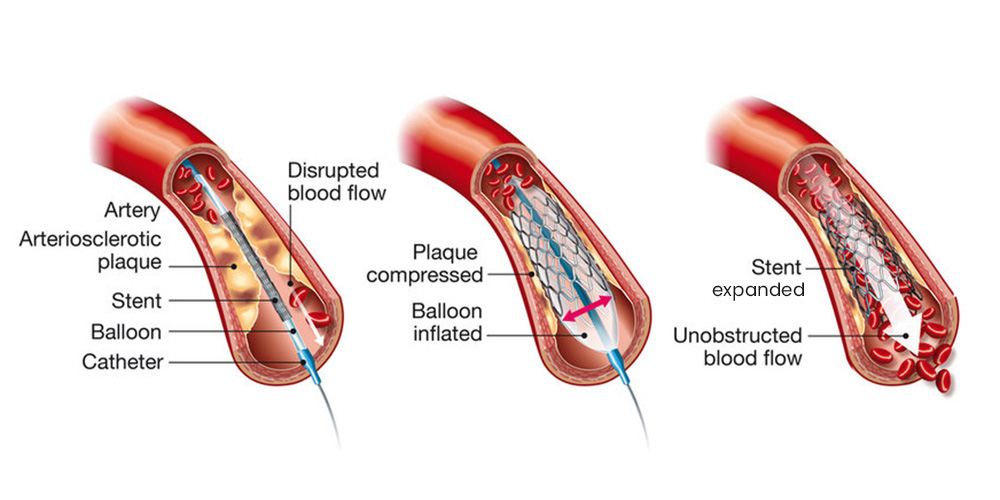
Coronary Angioplasty, also called Percutaneous Coronary Intervention (PCI) or Stenting, is a minimally invasive procedure used to open blocked or narrowed heart arteries and restore normal blood flow to the heart muscle. This procedure is commonly performed to treat coronary artery disease and is often life-saving in patients with heart attack.
1. Indications
Angioplasty is recommended when coronary angiogram shows significant blockage in one or more coronary arteries, especially in the following situations:
•Acute heart attack (Primary angioplasty)
•Severe chest pain not controlled with medicines
•High-grade coronary artery blockage
•Unstable angina
•Multi-vessel coronary artery disease in selected patients
•Blockage in previously placed stent
•High-risk patients not suitable for bypass surgery
•Diabetic patients with critical coronary artery disease
In emergency heart attack cases, angioplasty is the best treatment to quickly restore blood flow.
2. Procedure
Angioplasty is performed in the Cath Lab under local anesthesia.
A catheter is inserted through the wrist or groin artery and guided to the heart. A very thin wire is passed across the blocked artery. Over this wire, a balloon is advanced to the blockage and inflated to open the artery.
After the artery is opened, a stent is placed to keep the artery open permanently. Most commonly, Drug-Eluting Stents (DES) are used, which release medication to prevent re-blockage.
The procedure usually takes 30 minutes to 1.5 hours, depending on complexity.
Most patients can sit up and walk within a few hours when wrist approach is used.
Methods Used in Modern Angioplasty
•Radial approach (wrist access)
•Drug eluting stents
•IVUS / OCT imaging guidance
•High pressure balloons
•Intravascular lithotripsy (for calcium)
•Rotablation / Orbital atherectomy
•Microcatheters and specialized wires
These advanced methods increase success rate and safety.
3. Benefits
•Immediate relief of chest pain
•Prevents heart attack damage
•Improves heart function
•Avoids open heart surgery in many patients
•Short hospital stay
•Quick recovery
4. Safety
Coronary angioplasty is very safe in experienced hands, with very high success rates.
Possible risks (rare) include:
•Bleeding at puncture site
•Stent thrombosis
•Contrast allergy
•Kidney function change
•Heart rhythm problems
We perform angioplasty using latest generation stents, imaging guidance, advanced atherectomy devices, and strict safety monitoring to achieve best outcomes.
We perform angioplasty using latest generation stents, imaging guidance, advanced atherectomy devices, and strict safety monitoring to achieve best outcomes.